






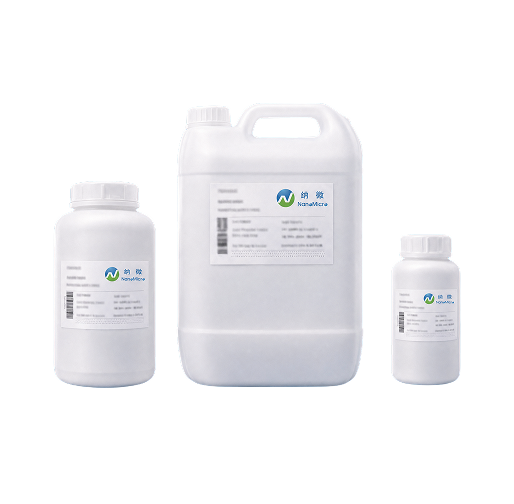


NanoQ-30L Ion Exchange Chromatography Resin
Ion exchange chromatography separates molecules based on differences in surface charge (type, quantity, and distribution), and is the most widely used method for the purification of biomacromolecules. NanoMicro's ion exchange chromatography resins are based on polymer matrices (polyacrylate or polystyrene-divinylbenzene copolymers) that undergo surface hydrophilic modification before being coupled with ion exchange groups, offering excellent biocompatibility and physicochemical stability for bioactive macromolecules, greatly improving purification efficiency. The Nano series ion exchange products from NanoMicro are designed for the polishing of antibodies, proteins, peptides, nucleic acids, and small molecule drugs.
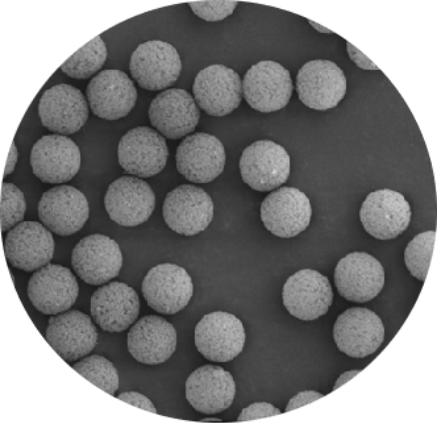
Figure 1. SEM image of NanoQ-30L
Key features of NanoQ-30L:
Hydrophilic surface modification
High mechanical strength
High resolution
Low back pressure
Long service life
Excellent resistance to acid and alkali over extended periods
Performance Specifications
| Name | NanoQ-30L |
| Separation Principle | Strong anion exchange |
| Matrix | Monodisperse polystyrene/divinylbenzene (PS-DVB) |
| Particle Size | ~ 30μm |
| Ligand | —CH2N+(CH3)3 |
| Ligand Density | ~0.21 meq/mL |
| Dynamic Binding Capacity | ~45 mg/mL (BSA) |
| Max Pressure | 2.0 MPa |
| CIP | 0.5 M NaOH |
| Recommended Flow Rate | 250-1000 cm/h |
| pH Stability | Working pH: 2~12; CIP pH: 1-14 |
| Chemical Stability | Compatible with all commonly used buffers, 1 M acetic acid, 1 M sodium hydroxide, 1 M hydrochloric acid, 70% ethanol, 30% isopropanol, 30% acetonitrile, 1% SDS, 6 M guanidine hydrochloride, 8 M urea, and other common organic solvents; avoid contact with strong oxidizing agents. Do not expose to strong oxidants (e.g., hypochlorite), oxidizing acids (e.g., nitric acid), strong reducing agents (e.g., sulfite), acetone, or benzyl alcohol. |
| Operating Temperature | 4~30 ℃ |
| Storage Conditions | 20% ethanol, 4~25 ℃ |
Notes:
1. The pH stability range refers to the pH range for use, regeneration, and CIP.
2. Dynamic binding capacity: Lysozyme is used for cation exchangers, and bovine serum albumin (BSA) for anion exchangers.
Ordering Information
| Product | Package Size | Catalog # |
| NanoQ-30L | 30 mL | 04044-030100-2030 |
| 50 mL | 04044-030100-2050 | |
| 100 mL | 04044-030100-2100 | |
| 300 mL | 04044-030100-2300 | |
| 500 mL | 04044-030100-2500 | |
| 1 L | 04044-030100-1001 | |
| 5 L | 04044-030100-1005 | |
| 10 L | 04044-030100-1010 | |
| 50 L | 04044-030100-1050 | |
| 100 L | 04044-030100 -1100 |