
Insulin Purification Application Case
Introduction
Insulin is a peptide hormone (approximately 7.5 KD) and one of the most important medications (injectable) for treating diabetes (Type I), one of the diseases affecting the largest patient population today. Therefore, it requires high purity and other technical specifications. Insulin drugs are classified into animal (bovine, porcine) insulin, (recombinant) human insulin, and insulin analogs (glargine, detemir, degludec, aspart, etc.). Their sources include animal tissue extraction, prokaryotic (E. coli) and eukaryotic (Pichia pastoris) fermentation.
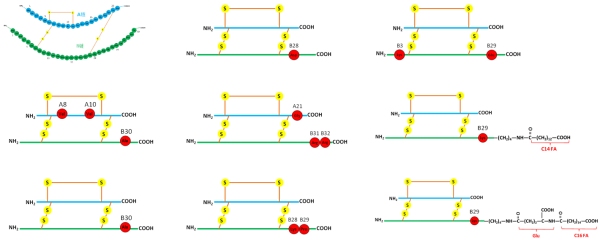
Figure 1. Schematic diagram of molecular structures of human insulin, animal insulin, and insulin analogs (including insulin icodec)
Challenges in Insulin Purification
The precursors (preproinsulin) obtained from the various methods above contain various impurities and must undergo complex purification, cleavage, and modification steps to ultimately yield insulin and its analogs as active pharmaceutical ingredients (APIs) with purity exceeding 99% (HPLC).
The purification process involves filtration, chromatography, and crystallization. Chromatography alone may include 3 to 5 steps, including upstream cation exchange capture of (pre)proinsulin, anion or cation exchange purification of the intermediate enzymatic cleavage products, purification of modified products (detemir, degludec), and final reversed-phase silica polishing.
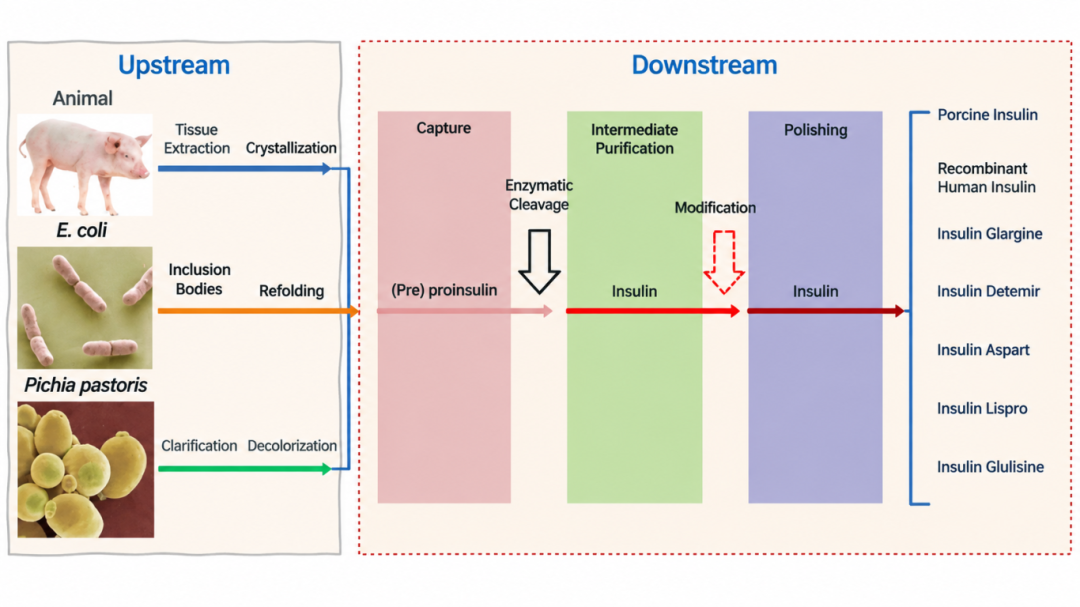
Figure 2. Schematic diagram of production processes for different types of insulin APIs
NanoMicro Insulin Purification Resins
The chromatography steps mentioned above have predominantly relied on imported resins. To enable domestic substitution of chromatography resins for insulin purification, NanoMicro has made sustained efforts over the years and has progressively launched a series of high-performance monodisperse chromatography resins, such as UniGel-80SP, UniPMMS-60M, NanoSP-15L, NanoQ-15L, UniPS 10-300, and UniSil 8-120 C8 Ultra. While providing customers with high-performance and cost-effective products, we also offer advantages such as stable pricing, short lead times, and no need for large advance inventory, eliminating concerns about supply chain disruptions due to international situations.
Application of Nano 15S in Post-Enzymatic Cleavage Purification of Insulin Glargine
NanoSP-15L is a monodisperse cation exchange chromatography resin with a PS-DVB matrix, similar to SOURCE 15S, launched early by NanoMicro. It features high mechanical strength, high resolution, and high binding capacity. It has been widely tested and recognized in domestic insulin purification projects and has been selected by multiple customers as the preferred resin for production registration.
In the process of domesticating insulin purification resins, NanoMicro leveraged its strong R&D capabilities. Without altering any process conditions (including bed height, mobile phase composition, elution gradient, sample loading, product purity, and yield), we developed a customized chromatography resin, Nano 15S, that fully replaces SOURCE 15S. Through rigorous production-scale testing, the final results, including the elution peak profiles, perfectly reproduced those of the imported resin, successfully achieving domestic resin substitution at production scale.
Table 1. Comparison of insulin intermediate purification results between Nano 15S and SOURCE 15S
| Resin | Batch No. | Crude Purity | Product Purity | Purification Yield |
|---|---|---|---|---|
| Nano 15S | J10W231F | 76.50% | 96.22% | 96.64% |
| Source 15S | 10278381 | 96.37% | 95.17% |
Summary
In this production-scale resin replacement case, where no other chromatographic conditions could be modified except for the resin itself, NanoMicro demonstrated precise control over the resin manufacturing process. Through simultaneous optimization of multiple variables, we achieved a high degree of consistency with the competitor resin results, successfully completing the domestic substitution. The effort required for this far exceeds that of developing a good chromatography resin.
This imported resin replacement case, from resin development, adjustment, and scale-up, fully demonstrates NanoMicro's capabilities in resin R&D and manufacturing. It also alleviates customers' last concerns about domestic substitution of imported resins, providing greater flexibility in future purification production, free from constraints of imported resin pricing and lead times, and immune to impacts from future international political, economic, and trade situations.
Note: For the full version, please contact us.
Ordering Information
| Product Name | Package Size | Catalog # |
|---|---|---|
| Nano 15S | 10 mL | 04042-015101-2010 |
| 50 mL | 04042-015101-2050 | |
| 100 mL | 04042-015101-2100 | |
| 500 mL | 04042-015101-2500 | |
| 1 L | 04042-015101-1001 | |
| 5 L | 04042-015101-1005 | |
| 10 L | 04042-015101-1010 | |
| 50 L | 04042-015101-1050 | |
| 100 L | 04042-015101-1100 | |
| NanoSP-15L | 10 mL | 04042-015100-2010 |
| 50 mL | 04042-015100-2050 | |
| 100 mL | 04042-015100-2100 | |
| 500 mL | 04042-015100-2500 | |
| 1 L | 04042-015100-1001 | |
| 5 L | 04042-015100-1005 | |
| 10 L | 04042-015100-1010 | |
| 50 L | 04042-015100-1050 | |
| 100 L | 04042-015100-1100 |
*This table shows only a portion of NanoMicro's ion exchange resins. For other resin requirements, please contact us.