Efficient Purification of Oligonucleotides with NanoQ and UniPS
Oligonucleotide Purification Process
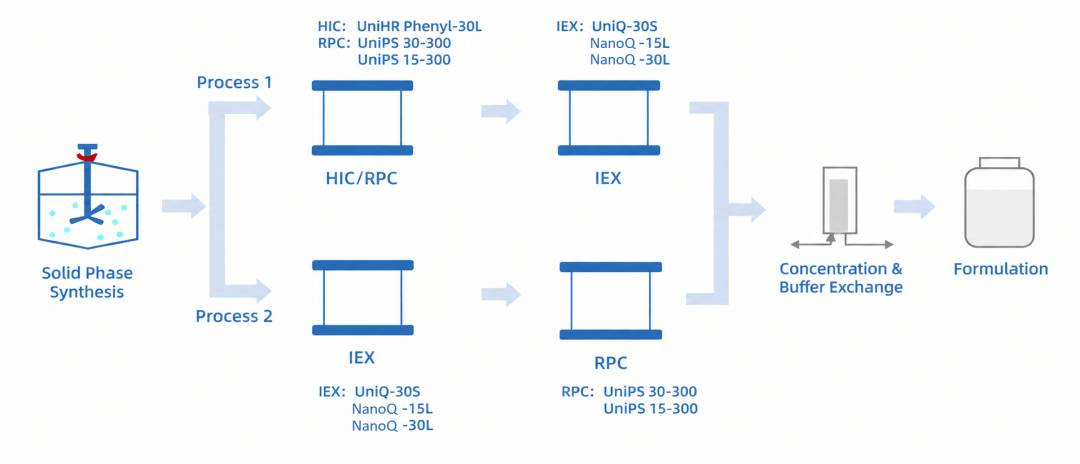
Oligonucleotide purification is a critical step in ensuring their quality and activity. Various impurities generated during synthesis, such as product-related "N-X" and "N+X" impurities and modification by-products, must be removed through an efficient purification process. In practice, oligonucleotide purification often requires a combination of multiple chromatography techniques to achieve optimal separation: reversed-phase chromatography (RP) or hydrophobic interaction chromatography (HIC) is first used to remove the majority of impurities, followed by high-resolution strong anion exchange chromatography (AEX) for polishing to remove product-related impurities. Auxiliary techniques such as ultrafiltration and diafiltration can remove residual small-molecule impurities and salts.
Leveraging years of expertise in microsphere R&D and downstream bioprocessing, NanoMicro introduces its oligonucleotide purification solutions:
◆ Overcoming traditional limitations: efficient impurity removal through microsphere material innovation
◆ Process upgrade: reduced purification time and lower cost
◆ Full workflow support: from process development to large-scale production
Application Case
1. NanoQ-15L Anion Exchange Resin for Oligonucleotide Purification
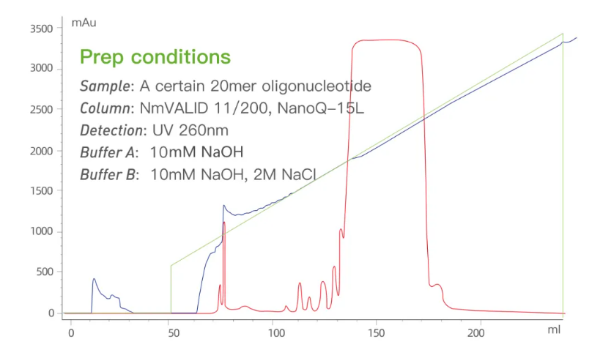
Figure 1. Purification of a 20-mer oligonucleotide using NanoQ-15L
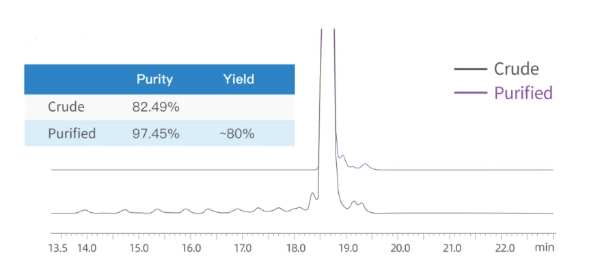
Figure 2. Key performance verification of the oligonucleotide purification process (HPLC analysis)
Purification Results
In the purification of a 20-mer oligonucleotide, NanoMicro NanoQ-15L was used for preparative-scale purification. HPLC analysis of the crude product showed a main peak purity of only 82.49% (Figure 2, black), with major impurities being N-1 shortmers (12.7%) and residual DMT protecting groups (4.8%). After optimized linear gradient elution, the main peak purity was significantly increased to 97.45% (Figure 2, purple), with critical impurity control achieving: N-1 <1.5%, DMT <0.3%. The process yield was approximately 80% (quantified by A260), meeting the cGMP requirement of >70%.
2. UniPS 10-300 Polymeric Reversed-Phase Resin for Oligonucleotide Purification
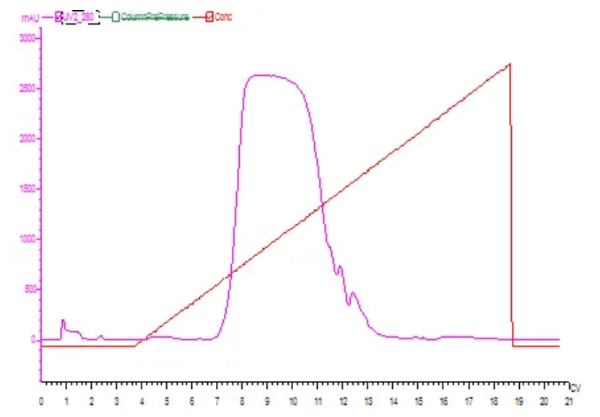
Figure 3. Purification of oligonucleotides using UniPS 10-300
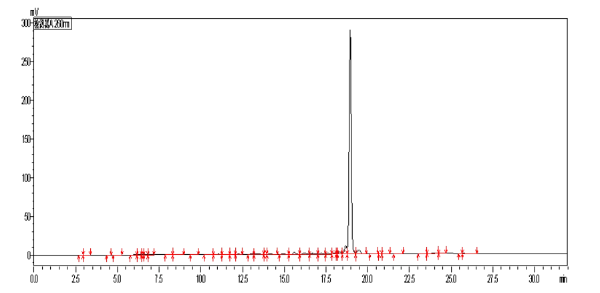
Figure 4. Key performance verification of the oligonucleotide purification process (HPLC analysis - crude)
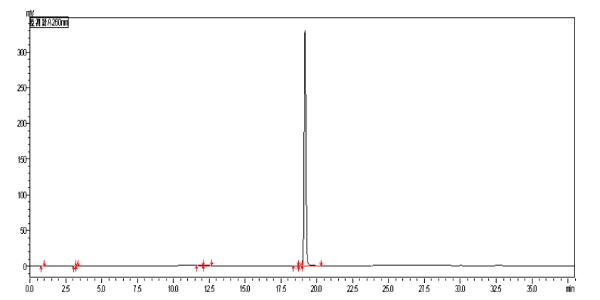
Figure 5. Key performance verification of the oligonucleotide purification process (HPLC analysis - purified)
Purification Results
In the purification of a 20-mer oligonucleotide, NanoMicro NanoQ-15L was used for preparative-scale purification. HPLC analysis of the crude product showed a main peak purity of only 82.49% (Figure 2, black), with major impurities being N-1 shortmers (12.7%) and residual DMT protecting groups (4.8%). After optimized linear gradient elution, the main peak purity was significantly increased to 97.45% (Figure 2, purple), with critical impurity control achieving: N-1 <1.5%, DMT <0.3%. The process yield was approximately 80% (quantified by A260), meeting the cGMP requirement of >70%.
Keywords:
Oligonucleotides