Daptomycin Purification Case Study
Introduction
Microorganisms are an important source of natural product-based drugs, and many antibiotic drugs derived from Streptomyces have long been at the forefront of the fight against bacterial infections. From the advent of the first antibiotic, penicillin, to the development and widespread clinical application of an increasing number of antibiotics, antibiotics have saved countless lives. However, with the irrational use of antibiotics, bacterial resistance has increased year by year. The emergence of a series of highly pathogenic drug-resistant strains, including methicillin-resistant Staphylococcus aureus (MRSA), vancomycin-resistant Enterococci (VRE), and penicillin-resistant Streptococcus pneumoniae (PRSP), has prompted global reflection on the rational use of antibiotics—the development of novel antibiotics is crucial. Daptomycin is a novel antibiotic that was launched amid such high expectations.
Daptomycin is a novel cyclic lipopeptide antibiotic, hailed as a "super antibiotic." It is produced by fermentation of Streptomyces roseosporus. As an acidic cyclic ester peptide compound, daptomycin possesses a novel chemical structure. It consists of 13 amino acids, with 10 arranged in a ring and 3 in a linear chain, and its terminal L-Trp is linked to a decanoic acid side chain.
Its mechanism of action differs from that of any other antibiotic. It binds to the bacterial cell membrane and causes rapid depolarization of the membrane potential, ultimately leading to bacterial cell death. Daptomycin is a hydrophilic antibiotic with strong penetration into tissues such as skin, bone, and thrombi. It requires administration only once every 24 hours and exhibits potent bactericidal activity against methicillin-resistant Staphylococcus aureus (MRSA), as well as antimicrobial activity against vancomycin-resistant Enterococci (VRE), vancomycin-intermediate Staphylococcus aureus (VISA), and heterogeneous vancomycin-intermediate Staphylococcus aureus (hVISA).
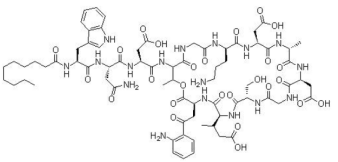
Daptomycin structural formulaIn the late 1980s, Eli Lilly and Company first prepared daptomycin and began its research. In 1997, Eli Lilly transferred the global development, manufacturing, and marketing rights of daptomycin to Cubist Pharmaceuticals, which made it a key development project. In September 2003, the US FDA approved daptomycin for marketing. The approved dosage form was a sterile powder for injection, marketed under the trade name Cubicin® (Daptomycin for injection), available in 250 mg and 500 mg strengths, for the treatment of complicated skin and skin structure infections caused by Gram-positive bacteria in adults. This was the first approved product among cyclic lipopeptide antibacterial agents. Subsequently, daptomycin was launched in Germany, the UK, and the Netherlands, and was officially launched in China in 2010.
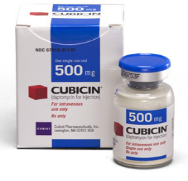
Daptomycin product
After more than 5 years of monopoly by the originator drug, the import monopoly was broken with the launch of the first daptomycin generics by Huadong Medicine and Hisun Pharmaceutical in 2015. Subsequently, generic versions from Hengrui Medicine, Zhejiang Medicine, and others were launched. Currently, the daptomycin industry in China is characterized by a production landscape dominated by major enterprises such as NCPC, Zhejiang Medicine, Hisun Pharmaceutical, and Huadong Medicine, with the original Cubist drug holding a relatively small market share.
Challenges in Daptomycin Purification
Industrially, daptomycin is primarily produced via microbial fermentation, with the process mainly consisting of fermentation and purification steps. The fermentation stage generates a significant number of impurities, making separation and purification difficult. During the purification process, other impurities such as daptomycin lactone hydrolysate, daptomycin β-isomer, and anhydrodaptomycin can also be generated due to factors like temperature and humidity. These impurities can affect the intended therapeutic efficacy of the drug, thereby impacting treatment safety. Furthermore, due to the wide variety of process-related impurities, they cannot be removed through a single chromatography purification step. Therefore, downstream purification of daptomycin presents challenges, requiring the downstream process to exhibit good selectivity and resolution.
Purification Results
A customer, facing high costs associated with existing imported resins and processes, requested a switch to domestic resins to reduce production costs. Based on the customer's requirements and addressing the challenges of daptomycin separation and purification, NanoMicro successfully developed a two-step chromatography purification process combining ion exchange and reversed-phase silica, leveraging its years of experience in chromatography resin development and process development. This process demonstrates excellent purification performance for daptomycin samples. First, the two-step purification method effectively removes impurities with good separation performance, achieving levels of both known and unknown impurities below customer requirements.
Second, through repeated validation, the process is stable, achieving a recovery rate of 80% with a purity as high as 97%, matching the purification performance of imported resins.
Conclusion
The two-step chromatography purification process for daptomycin successfully developed by NanoMicro exhibits excellent separation performance and high recovery, and can fully replace imported chromatography resins used in daptomycin purification and preparation. This process has now been scaled up for industrial production, meeting recovery and purity requirements while significantly reducing production costs for the enterprise.
Note: For the full version, please contact us.
Ordering Information
Product Name | Package Size | Catalog # |
UniQ®-50XS | 30 mL | 04024-050030-2030 |
100 mL | 04024-050030-2100 | |
1 L | 04024-050030-1001 | |
10 L | 04024-050030-1010 | |
100 L | 04024-050030-1100 | |
UniSil® 10-120 C18 Ultra Plus | 100 g | 19201-100012-4100 |
500 g | 19201-100012-4500 | |
1 Kg | 19201-100012-3001 | |
10 Kg | 19201-100012-3010 | |
20 Kg | 19201-100012-3020 |
*This table only shows a portion of NanoMicro's chromatography resins. Please contact us for other requirements.