






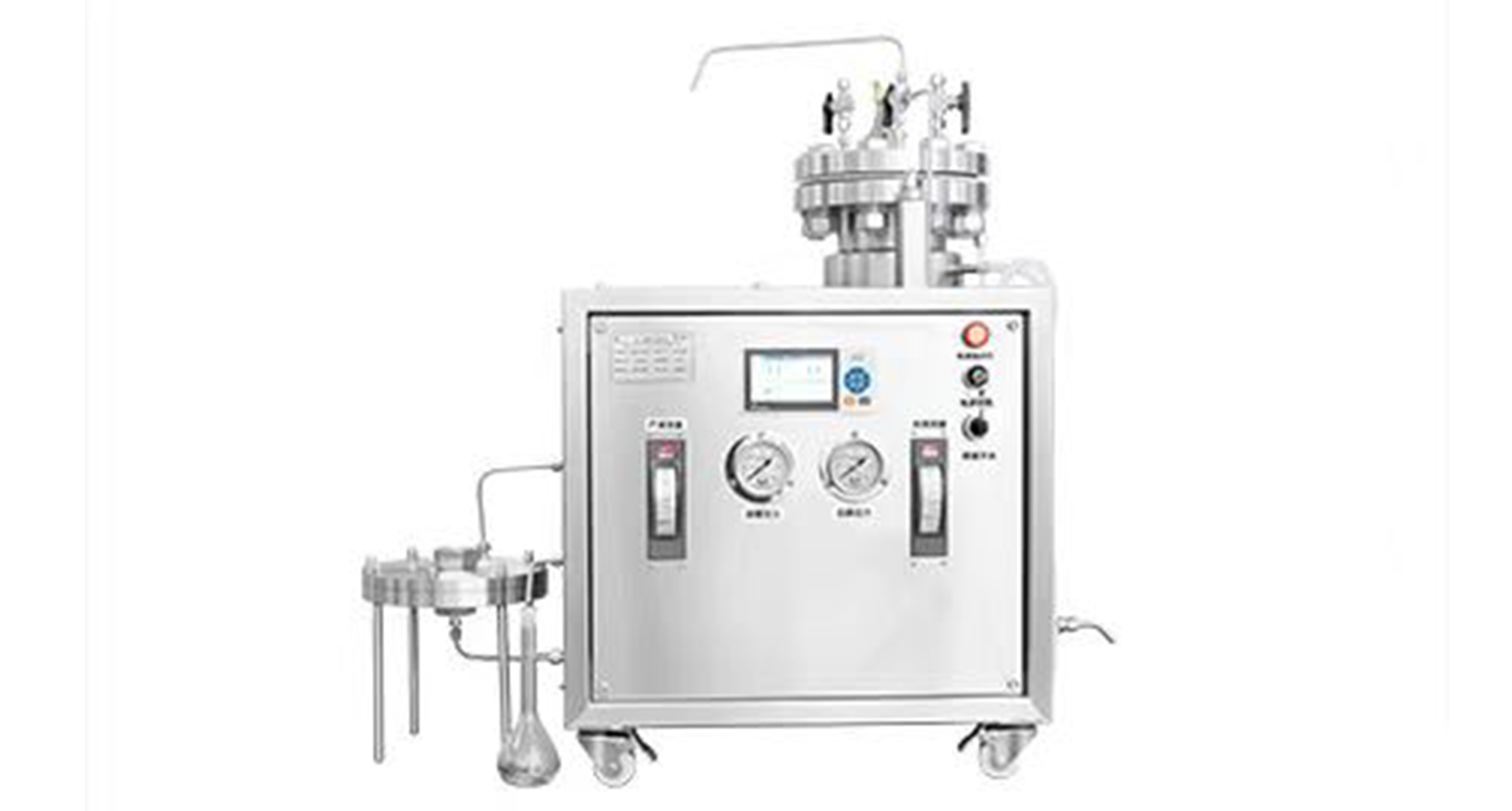
OSM-LabST 300
The OSM-LabST 300 solvent-resistant concentration and impurity removal workstation is an entry-level solution designed for users new to solvent-resistant nanofiltration or with limited budgets. With a minimum circulation volume of 300 mL and a processing capacity of 1L–5L per hour, this system delivers stable and reliable core functionality with a streamlined configuration and cost-effective investment, enabling users to complete process feasibility validation and small-scale sample processing with ease. The system features an intuitive manual control interface, with all critical operations managed directly via physical buttons and knobs, eliminating the learning curve of complex programming and software. Operating status is clearly visible at a glance, making it ideal for R&D environments that prioritize directness and controllability. Its compact footprint and space-saving design reduce maintenance complexity while ensuring system sealing and durability. As the entry-level choice, i

Product Description
Applications: Covering Multiple Process Development Workflows
1. Small-molecule API concentration and impurity removal
2. Biologics (protein/peptide) desalting and buffer exchange
3. Natural product extract concentration and solvent exchange
4. Fine chemical intermediate purification and solvent recovery
5. CRO/CMO multi-project process validation and custom experiments
Core Value: 3 Key Advantages Addressing R&D Challenges
POC Proof-of-Concept • Low-Cost Efficiency | Full-Chain Compatibility • No Scale-Up Barriers | Precise Data Acquisition • Reproducible Process |
Designed for early-stage R&D/CRO with limited sample volumes and tight timelines, we provide efficient feasibility validation for micro-scale samples, covering core processes such as API concentration, solvent exchange, and desalting/salt exchange to avoid wasted investment. | Membrane materials, consumables, and components are consistent with commercial scale-up production, providing authoritative "material compatibility + extractables/leachables" data that resolves the industry pain point of "feasible in the lab, not feasible in production." | Real-time monitoring of critical parameters such as membrane flux and rejection rate enables comprehensive evaluation of membrane processing capacity, tolerance, fouling resistance, and cleaning/recovery performance, providing reproducible, solid data for process finalization. |
Flexible Configuration: Tailored to Diverse R&D Needs
Membrane Cassette Type Matching
Membrane Model | Applicable Solvent Systems | Core Applications | Recommended Priority |
PHD | Alcohol/water, low-to-medium concentration acetonitrile-water | Routine API concentration, desalting, buffer exchange | First choice for high-throughput desalting |
PHF | Alcohol/water, low-to-medium concentration acetonitrile-water | Routine API concentration, desalting, buffer exchange | First choice for API concentration and buffer exchange |
PHR | Alcohol/water, low-to-medium concentration acetonitrile-water | Polar solvent impurity removal and purification | Polar solvent purification |
DHR | High-concentration acetonitrile-water, DMF/acetone | API concentration and solvent impurity removal in highly polar solvent systems | Dedicated to high-concentration polar solvents |
NHR | Alkanes, ethyl acetate, halogenated alkanes, aromatic hydrocarbons | API concentration and solvent impurity removal in non-polar solvent systems | Dedicated to non-polar solvents |
* Note: 1. Membrane cassette area options: 0.005/0.05/0.1 m²
Robust Specifications: Stable and Reliable for Complex Environments
• Pressure Control:Up to 40 bar, precise adjustment
• Temperature Compatibility:Operating temperature up to 40 °C
• pH Tolerance:Long-term 3-10, short-term 2-12
• Material Compatibility:SUS316L medical-grade stainless steel + solvent-resistant primary/secondary materials
• Ease of Operation:Integrated design with easy-to-clean tubing
Ordering Information


