






Solvent Purification System
Leveraging precise pore-size sieving for solute-solvent separation, our system delivers organic solvent purification and recovery for industrial applications, backed by full life-cycle technical support.

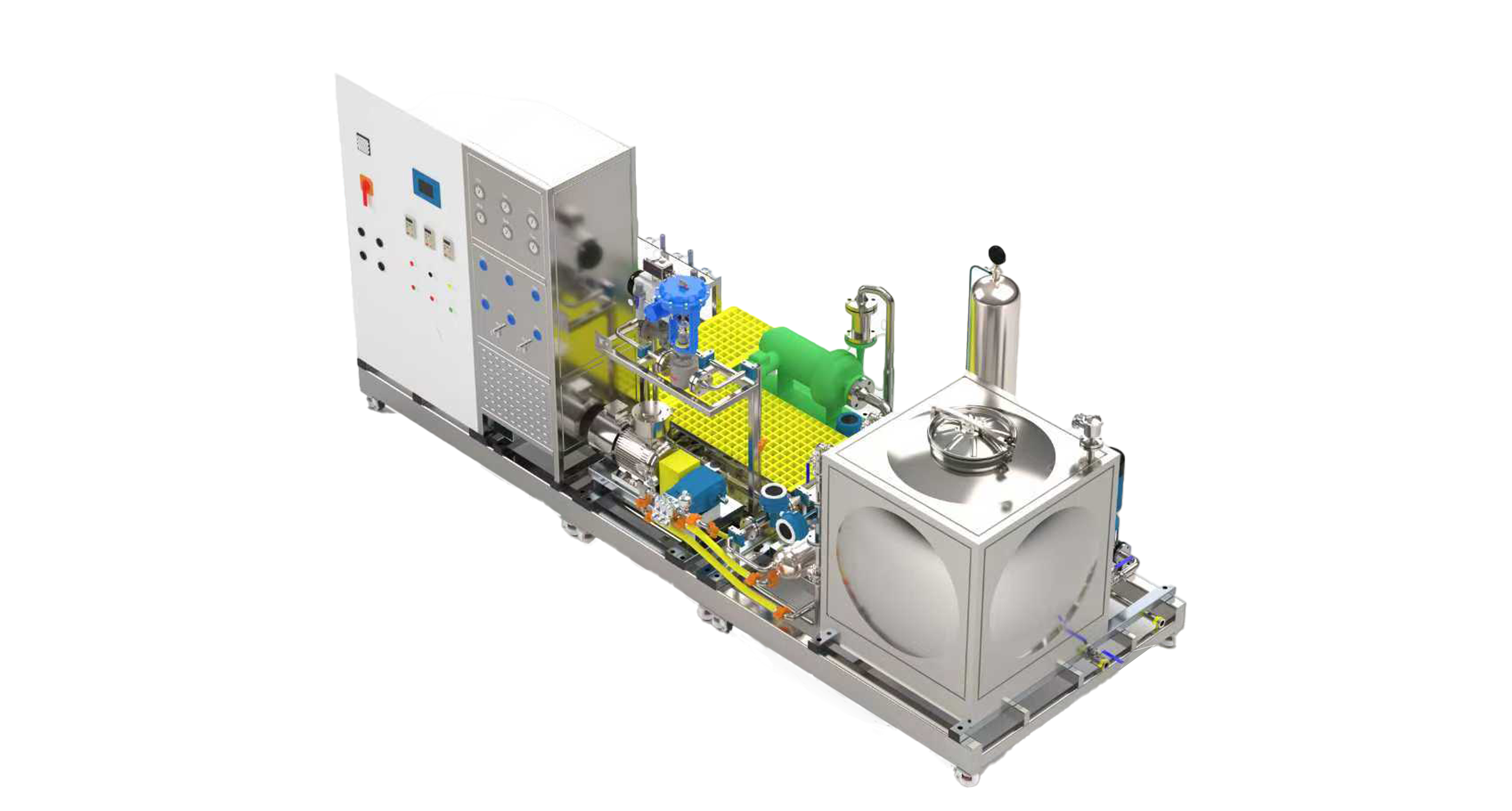
Product Description
Background:
The pharmaceutical industry consumes large volumes of organic solvents during reaction and purification processes. To address the dual challenges of environmental pressure and cost control, solvent recovery has become essential. Currently, pharmaceutical manufacturers primarily rely on distillation and rectification for solvent recovery, but these methods have significant limitations: high energy consumption, low efficiency, poor suitability for heat-sensitive materials, and safety risks associated with high-temperature operations. In contrast, membrane-based solvent recovery systems effectively overcome these limitations. Our systems enable continuous solvent purification at low or ambient temperatures, support concentration of drug molecules in various solvent systems, and ensure full compliance with regulatory requirements.
Key Advantages:
Our membrane-based solvent recovery system not only enables continuous solvent purification at low or ambient temperatures but also supports concentration of drug molecules in various solvent systems, all while ensuring regulatory compliance.
Compared to traditional thermal processes, membrane technology offers the following advantages:
1. Reduced energy consumption: up to 80% energy savings compared to thermal methods;
2. Simplified process: 5-10x shorter processing time;
3. Solvent recovery: recovery rate exceeding 90%;
4. GMP-compliant design;
5. Highly automated, easy and safe operation.
Core Technology:
Nanotin leverages proprietary highly cross-linked polymer membrane materials, delivering exceptional chemical stability and high retention performance (molecular weight cut-off range of 120 - 700 Da). By precisely controlling membrane pore size at the molecular scale, our organic solvent-resistant membranes achieve efficient solute-solvent separation, enabling ultra-pure solvent recovery and concentration of target molecules in pharmaceutical applications. All wetted materials in the membrane system are carefully optimized to ensure optimal stability in solvents. Furthermore, the wide-channel design provides excellent fouling resistance, overcoming the challenge of rapid permeate flux decline commonly observed in traditional ultrafiltration membranes during concentration.
Methanol | Ethanol | Acetonitrile-Water | Hexane | Heptane | Ethyl Acetate | Xylene | Halogenated Alkanes | |
P Series | |
| | |||||
N Series |
|
|
|
|
|

Typical Solvent Resistance of Membranes
Our end-to-end solvent management platform integrates multiple unique advantages: broad pH adaptability, stable operation under demanding high-concentration solvent conditions, industry-leading solvent recovery efficiency, and full compliance with GMP certification and fine chemical quality control requirements.

Solvent Recovery Systems
Product Overview:
P Series and N Series membranes are designed for polar and non-polar solvent systems, respectively. To ensure long-term, stable, and superior performance across different solvent systems, our membranes feature:
1. Excellent stability and low extractables in solvents
2. High solvent permeability
3. High retention of APIs
Typical Performance - Retention
API molecular weight,Da |

Note: Given the complexity of the solvent-solute-membrane ternary system interactions, we strongly recommend users conduct performance validation with actual process feed streams.

Typical Applications of Membrane Technology in API Concentration and Organic Solvent Recovery
Application Example
Our solvent-resistant membranes can be applied to purify methanol used in the extraction of high-purity EPA from fish oil. As shown in the figure, the GC purity of methanol obtained via membrane filtration is approximately 99.95%, compared to 99.85% with traditional thermal methods. Methanol purified through the membrane system is recovered for use in EPA chromatographic purification, with EPA recovery and purity data comparable to those achieved with fresh methanol as a control. Membrane-based solvent recovery delivers approximately 50% savings in overall recovery costs due to lower energy consumption and higher system automation.

Fresh Solvent | Recovered Solvent | |||
Run | EPA Purity | EPA Recovery | EPA Purity | EPA Recovery |
1 | 99.14% | 94.73% | 99.08% | 94.65% |
2 | 99.09% | 94.73% | 99.10% | 94.87% |
3 | 99.13% | 94.65% | 99.03% | 94.90% |
4 | 98.99% | 94.75% | 98.98% | 94.97% |
5 | 99.01% | 94.63% | 99.06% | 94.93% |
EPA Extraction Results: Fresh Solvent vs. Recovered Solvent
Ordering Information


