





-
Magnetic Solid-Phase Extraction
-
Chemiluminescence Immunoassay
-
Particle Size Standards
-
Counting Standard Particles
-
Special Standard Particles
-
Flow Cytometry Encoding Microspheres
-
Flow Cytometry Absolute Counting Microspheres
-
Flow Cytometry Instrument QC Microspheres
-
Flow Cytometry Optical Alignment Microspheres
-
Nucleic Acid Extraction
-
Specific Hybrid Capture
-
NGS Library Fragment Size Selection
-
Protein Purification
-
Immunoprecipitation
-
Immunoturbidimetric
-
Immunochromatography

Immunochromatography

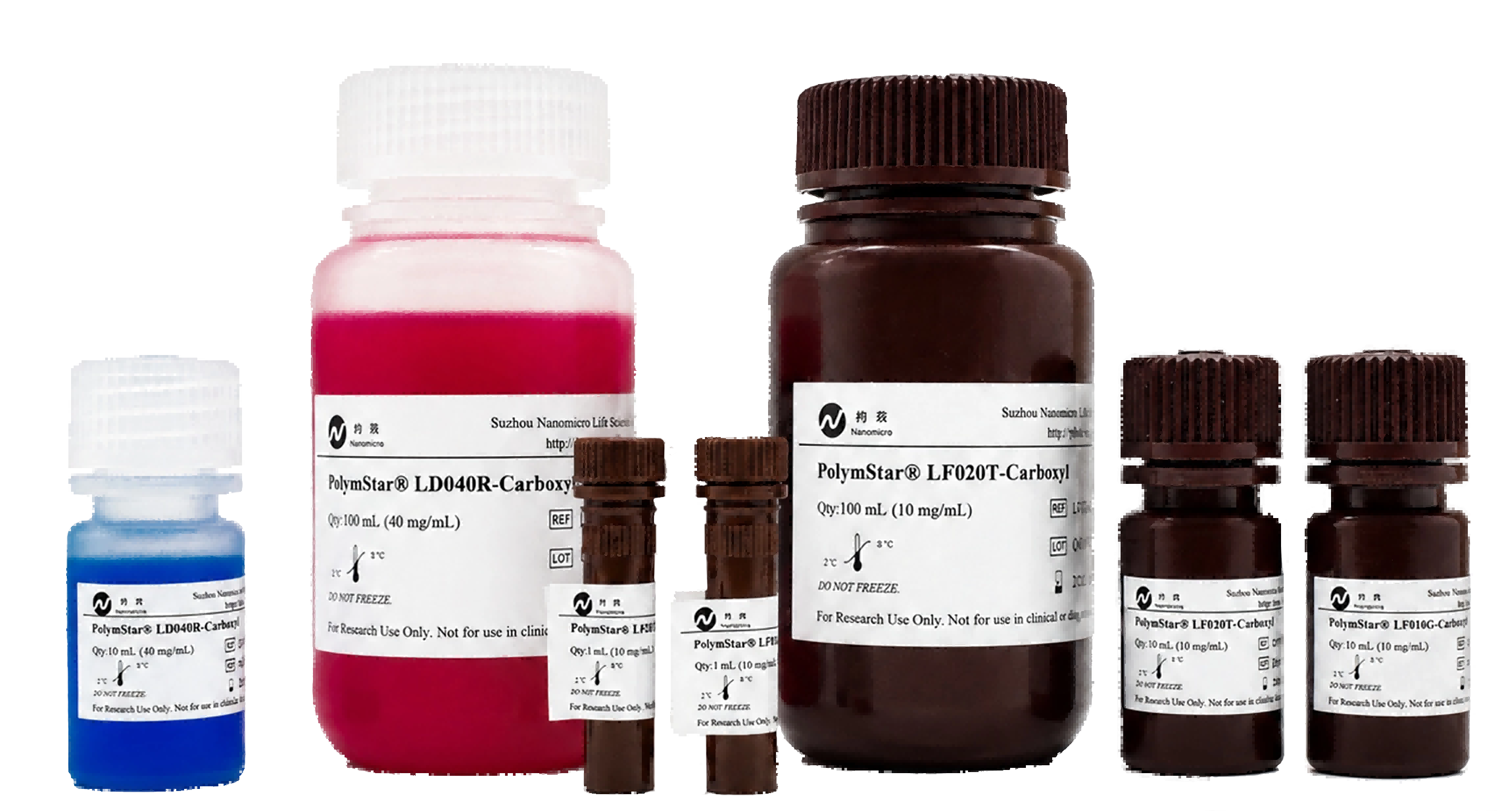
Product Description
Both colored and fluorescent polystyrene microspheres can be used as labels in qualitative and quantitative immunochromatographic assays to generate readable signals. Red and blue microspheres are the most commonly used in qualitative immunochromatographic tests, producing visible C and T lines. When developing quantitative immunochromatographic assay reagents, fluorescent microspheres containing europium (Eu) complexes are the most suitable choice. These microspheres typically range from 0.1 to 0.3 μm in particle size to meet different requirements for linear range and sensitivity across various projects.
Ordering Information
Swipe Left
| Product Code | Product Name | Particle Size (µm) | Functional Group | Fluorescence / Color | Solid Content | Package Size |
| LFTNC-010 | PolymStar® LF010T-Carboxyl | 0.10 | Carboxyl | Time-resolved fluorescence | 1% w/v | 1 mL /10 mL |
| LFTNC-020 | PolymStar® LF020T-Carboxyl | 0.20 | Carboxyl | Time-resolved fluorescence | 1% w/v | 1 mL /10 mL |
| LFTNC-030 | PolymStar® LF030T-Carboxyl | 0.30 | Carboxyl | Time-resolved fluorescence | 1% w/v | 1 mL /10 mL |
| LFTNC-040 | PolymStar® LF040T-Carboxyl | 0.40 | Carboxyl | Time-resolved fluorescence | 1% w/v | 1 mL /10 mL |
| LFGNC-010 | PolymStar® LF010G-Carboxyl | 0.10 | Carboxyl | Green fluorescence | 1% w/v | 1 mL /10 mL |
| LFGNC-020 | PolymStar® LF020G-Carboxyl | 0.20 | Carboxyl | Green fluorescence | 1% w/v | 1 mL /10 mL |
| LFGNC-030 | PolymStar® LF030G-Carboxyl | 0.30 | Carboxyl | Green fluorescence | 1% w/v | 1 mL /10 mL |
| LFGNC-050 | PolymStar® LF050G-Carboxyl | 0.50 | Carboxyl | Green fluorescence | 1% w/v | 1 mL /10 mL |
| LFONC-020 | PolymStar® LF020O-Carboxyl | 0.20 | Carboxyl | Orange fluorescence | 1% w/v | 1 mL /10 mL |
| LFONC-040 | PolymStar® LF040O-Carboxyl | 0.40 | Carboxyl | Orange fluorescence | 1% w/v | 1 mL /10 mL |
| LFONC-050 | PolymStar® LF050O-Carboxyl | 0.50 | Carboxyl | Orange fluorescence | 1% w/v | 1 mL /10 mL |
| LFRNC-020 | PolymStar® LF020R-Carboxyl | 0.20 | Carboxyl | Red fluorescence | 1% w/v | 1 mL /10 mL |
| LFRNC-030 | PolymStar® LF030R-Carboxyl | 0.30 | Carboxyl | Red fluorescence | 1% w/v | 1 mL /10 mL |
| LFDNC-020 | PolymStar® LF020D-Carboxyl | 0.20 | Carboxyl | Deep-red fluorescence | 1% w/v | 1 mL /10 mL |
| LFDNC-030 | PolymStar® LF030D-Carboxyl | 0.30 | Carboxyl | Deep-red fluorescence | 1% w/v | 1 mL /10 mL |
| LDRNC-020 | PolymStar® LD020R-Carboxyl | 0.20 | Carboxyl | Red (non-fluorescent) | 4% w/v | 10/100 mL |
| LDRNC-030 | PolymStar® LD030R-Carboxyl | 0.30 | Carboxyl | Red (non-fluorescent) | 4% w/v | 10/100 mL |
| LDRNC-040 | PolymStar® LD040R-Carboxyl | 0.40 | Carboxyl | Red (non-fluorescent) | 4% w/v | 10/100 mL |
| LDBNC-020 | PolymStar® LD020B-Carboxyl | 0.20 | Carboxyl | Blue (non-fluorescent) | 4% w/v | 10/100 mL |
| LDBNC-030 | PolymStar® LD030B-Carboxyl | 0.30 | Carboxyl | Blue (non-fluorescent) | 4% w/v | 10/100 mL |
| LDBNC-040 | PolymStar® LD040B-Carboxyl | 0.40 | Carboxyl | Blue (non-fluorescent) | 4% w/v | 10/100 mL |